“All Things Change”

Monday Ministerial Musings

By Rev. Mark William Ennis

2022 Blog #34

August 29, 2022

Summer Cinema Scenes in 10 parts

Part 9 “Star Trek Six, The Undiscovered Country”

“All Things Change”

I love the original Star Trek movies but have never been able to fully appreciate the newer ones with a newer cast. I appreciate the original characters far too much to transfer by loyalty to newer actors. My favorite of these original movies is Star Trek Six: The Undiscovered Country.

This movie, produced in 1991, describes the breakup of the Klingon Empire. It seems to be a reflection of the real life breakup of the Soviet Union between 1989-1991. There were many comparisons between the Soviet Union and this movie when it came to theaters. Two themes dominate this movie; all things change and some people live in fear of the future and wish to keep change from happening.

Several warriors from the United Federation of Planets as well as the Klingon Empire do not trust former opponents. The treaties , however flawed, had keep a state of relative peace. There wasn’t friendship between the two sides but there was peace. The political structure gave security to each side but small factions could not imagine the future without these structures, however imperfect they were.

A plot organized by high ranking members of the Federation as well as the Klingons is organized to keep the new promise of peace from ever happening. High placed officials were willing to thwart an unfolding future that they feared.

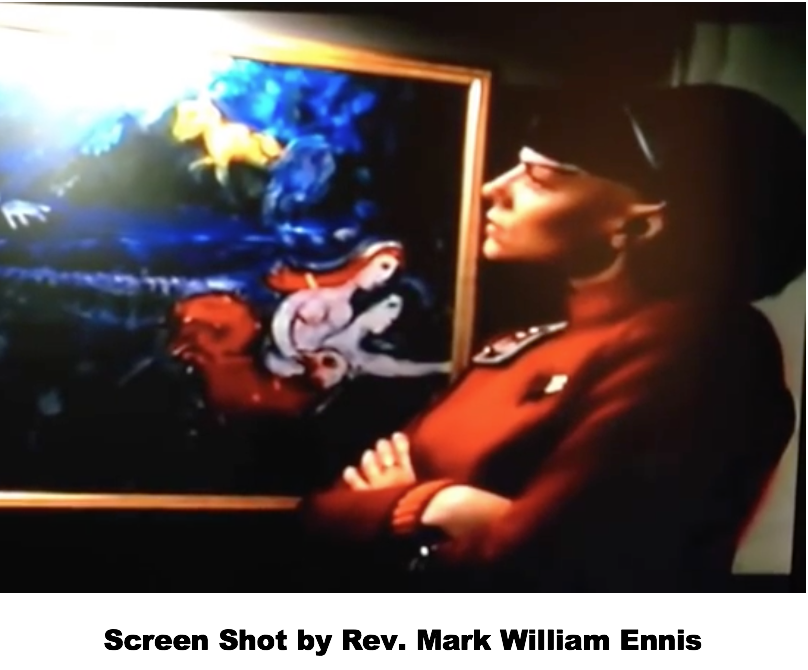
Captain Spock has been a major player in beginning peace talks between these factions. He is confronted by Lieutenant Valeris who fears the future changes. She asks Captain Spock about artwork in his quarters. He explains that it is a painting of the expulsion of humans from the Garden of Eden. Spock explains that it is a reminder that “all things end.”

Like many of the characters in this movie I don’t like change either. I enjoy stability and yet, change is always inevitable. Spock’s words, “all things end” reverberate for me. Things begin and things end. When new things begin will these things be good or bad? Perhaps they will be both good and bad. Perhaps it is up to us to manage the changes in our  lives to ensure that we can find positive outcomes in every change.

All things change. Whether the changes are positive or negative is largely up to us.

All things end https://www.youtube.com/watch?v=F4Op4vc3GBs
“I will remain Galadriel”

Monday Ministerial Musings

By Rev. Mark William Ennis

2022 Blog #33

August 22, 2022

Summer Cinema Scenes in 10 parts

Part 8 “The Lord of the Rings”

“I will remain Galadriel”

I first fell in love with JRR Tolkien’s “Lord of the Rings” when I was told about it in college. These stories were only in book form back then. The more recent movies were not thought of when I first discovered this three part story. I loved them then and I still love them.

The synopsis of the story is that there is an evil sorcerer who wants to dominate the world. The evil wizard, Sauron, lacks one thing to make this dream come true, the ultimate ring of power. This ring of power, by a long string of events, comes into the possession of Frodo, a meek and humble hobbit. A wise coalition of good wizards, humans, elves, dwarves and hobbits set about to destroy this one ring of power in order to keep it from the evil wizard.

Members of this coalition, as well as other characters, are tempted to seize this ring of power and use it in an attempt to topple the evil wizard. With good intentions, many characters face this temptation not knowing that possessing such power will change them into evil characters. One cannot have such power without it changing your character for the worse.

One such character is Galadriel, an Elf queen. She has been working to oppose the evil wizard and struggling to maintain all that is good in the world. She is a wise healer. Frodo, in order to end the evil of the world, with all good intentions, offers to give her the ring of power. He believes that she would use it with goodness and integrity to defeat the wizard Sauron. She declines this temptation for she fears what she shall become if she possessed unlimited power. She knows that her essence would change if she possessed this ring. Instead of being fair and just she would become an evil queen. The power would corrupt her.

Many of us desire more power to set things right in the world. There are times when we are tempted to adopt the philosophy “the end justifies the means.” When we adopt this way of thinking we begin a walk to the dark side.

Galadriel resists the temptation. She turns down the chance to have the ring. She would rather diminish than to become a powerful but evil queen. She knows the temptations of power. May we be so wise. When we battle evil forces in the world may we never use the same tactics of those doing evil or we might become like them and become evil ourselves.

The Lord of the Rings: https://www.youtube.com/watch?v=WeQDTj1UllA

“Don’t be afraid of who you are”

Monday Ministerial Musings

By Rev. Mark William Ennis

2022 Blog #32

August 15, 2022

Summer Cinema Scenes in 10 parts

Part 7 “The Rise of Skywalker”

“Don’t be afraid of who you are”

A few years ago, that latest Star Wars movie, “The Rise of Skywalker” debuted in theaters. It got only mixed reviews. I thoroughly enjoyed the movie and found it quite inspirational and has a valuable lesson for all of us.

This movie answers the question, “who is Rey?” Fans have been speculating about who Rey was since Star Wars first returned to the screen in 2015. Rey, much like Luke Skywalker before her, is a person gifted in the ways of the force but knows nothing of what the force even is. For two movies, we watched Rey get strong in the force and doing great things to protect the innocent from evil forces.

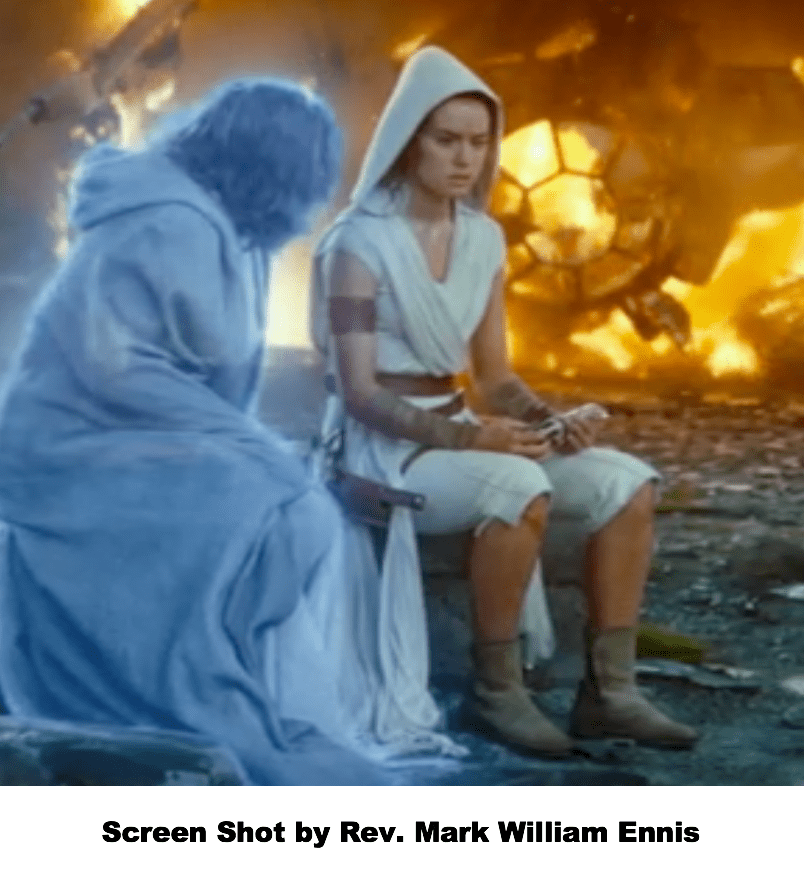
In this movie, Rey faces a crisis and puts herself into a self-imposed exile on a planet where in a prior movie Luke Skywalker had also exiled himself. Rey went into hiding because she feared who she was. The young woman had learned that she was the grand-daughter of the evil empire Palpatine. Rey fears that because of her lineage, she too will become an evil presence who uses her power for dark things. She fears who she is.

Master Luke Skywalker in force-ghost form meets her and assures her that he and Princess Leah both knew of Rey’s bloodline. Yet, they trained her in the Jedi arts despite her relation to the evil emperor. Master Luke assures her that Luke and Leah had seen Rey’s heart and spirit and that “some things are thicker than blood.”

Rey goes on to conquer the evil emperor and his empire. She proves that Master Luke is correct; if your relatives are evil it does not mean that you must be evil. One can make a new destiny apart from family lineage.

Do genetics matter? Of course. Family genetics can influence our personalities and how prone we are to certain illnesses and medical conditions. Yet, whether we live lives for evil or good is our decision to make. The lesson of this movie is simple: we need not be afraid of our family lineage, we make our own decisions on whether we will lead lives that bless or curse.

“Don’t be afraid of who you are.”

The Rise of Skywalker: https://www.youtube.com/watch?v=6eB_RfZJG78

“We’ll See”

Monday Ministerial Musings

By Rev. Mark William Ennis

2022 Blog #31

August 8, 2022

Summer Cinema Scenes in 10 parts

Part 6 “Charlie Wilson’s War”

“We’ll See”

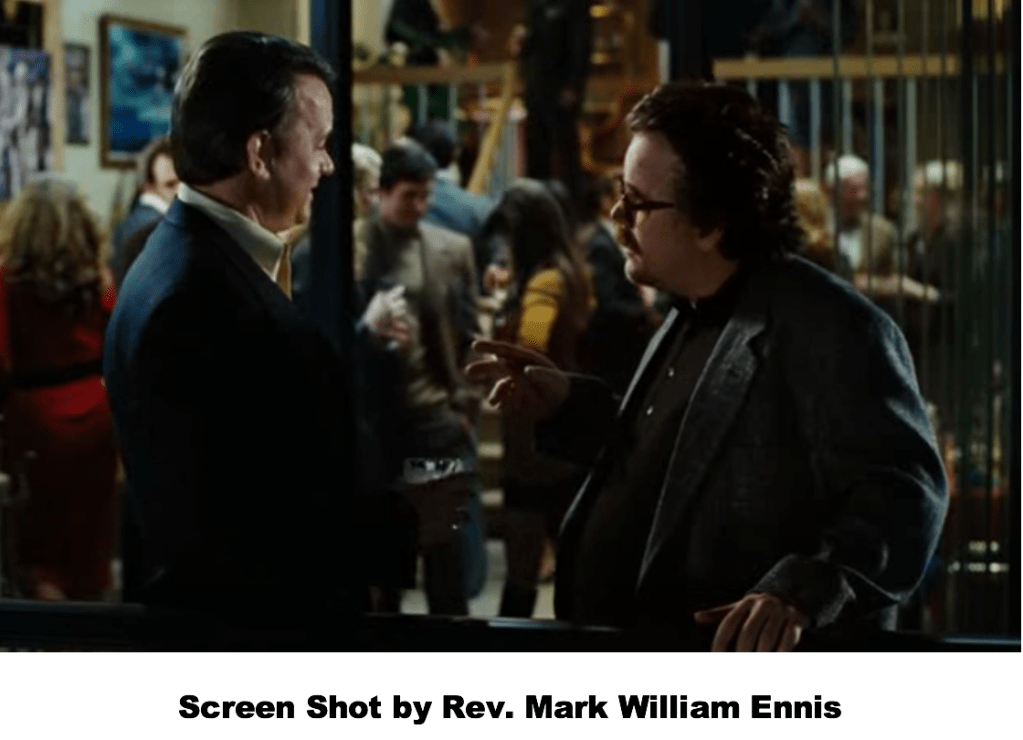
One of my all-time favorite movies is “Charlie Wilson’s War” which stars Tom Hanks and Julie Roberts. This chronicles the true story of Charlie Wilson, a congressional representative from Texas who engineered America’s covert involvement in forcing the Russian army out of Afghanistan in 1989. Charlie, a very little known member of congress, used favors and great political savvy to increase the funding and weapons to arm citizens of Afghanistan to fight a guerrilla war against the Russian invaders.

As the movie continues, I found myself celebrating the political prowess of Charlie Wilson and the victories of the freedom fighters. I felt the same feelings that I had when I would watch cowboy and Indian movies. I could clearly see the difference between the “good guys” and the “bad guys” and in the end the “good guys” win.

There is a growing euphoria as little by little the funding increases and the “good guys” have more victories. One man, a CIA agent with roots in rural Pennsylvania, doesn’t get sucked into the euphoria. He wants to tell Charlie, and anyone who will listen, the story of the Zen master. It is at the end of the movie that we finally here the story and the warning that it contains.

The story is as follows:

            There is a little boy who gets a horse on his fourteenth birthday. Everyone in the village says, “how wonderful that he got a horse.” The Zen Master says, “we’ll         see.”

            Two years later the little boy falls off his horse and breaks his leg and the whole   village says, “how terrible.” The Zen Master says, “we’ll see.”

            War breaks out and all the other boys go off to war except this boy because of     his leg injury. Because he doesn’t have to go to war the villagers say, “how        wonderful” but the Zen Master says, “we’ll see.”

The CIA agent is trying warning Charlie that with the Russians gone, there is a power vacuum in Afghanistan. We were not prepared to rebuild the infrastructure and become friendly with the population. In the wake of this power vacuum the Taliban come to power and ultimately we fought a futile war against that group. All of this came from our covert war against the Russian army.

The lesson in this is that consequences from our actions are not always what we think they will be. Let us be careful what we wish for and work for. We may just get it and the outcomes may not be what we have envisioned.

Charlie Wilson’s War: https://www.youtube.com/watch?v=B2L1-TgfKb4

“You Can’t Go Back”

Monday Ministerial Musings

By Rev. Mark William Ennis

2022 Blog #30

August 1, 2022

Summer Cinema Scenes in 10 parts

Part 5 “Field of Dreams”

“You Can’t Go Back”

I’ve seen the movie “Field of Dreams” many times. I still cry when I watch it. Friends of mine who also like this movie represent a dichotomy of opinion. Half of them cry through this movie and half laugh at those of us who cry through it. It seems to touch some of us more than others.

Those of us who cry through the movie all seem to cry through different scenes of the movie. In each of us, a different scene triggers an emotional response. This movie speaks to many people in many different ways for many different reasons.

My greatest cry scene revolves around a character named Doctor Graham. The first time we see him he is an older man and small time doctor. He has served this small town for decades. He is now taking care of the children of people that he once took care of. The opinion from many town folks is that he was generous, often waving fees for those who could not afford medical care and a supporter of local missions on behalf of those who were destitute. By all accounts, he was a well-loved man who did great things for his hometown. He does hold a secret disappointment, however. He was play minor league baseball and one game in the majors. Why didn’t he continue to play?

In this movie, Archie “Moonlight” Graham faces a choice as a young man. He is playing ball as a rookie when a little girl is choking. He faces a choice. He can continue playing ball or keep the girl from choking. Of course, movie choices are always simple and straight forward. He faces a choice; play baseball or use his skills to become a doctor who cares for residents of a small town. He chooses the latter and there is no going back once this choice is made. Yet, he always harbors a bit doubt wondering if he should have stayed in baseball.

I bet we can all recall such events in our lives. There were times when we all faced crossroads in our lives. The choices that we made at those times set the course of our futures. If we are fortunate we have few regrets about the choices that we made. More importantly, I hope that the choices that we made led us to lives of doing good and not harm. We can always think about “what if” about our former past decisions but the real questions are, “are we doing well for others?” and “have we found happiness with the lives we lead?” We can’t go back and redo our lives.

So why do I love this scene? It reminds me of me as a child. I always wanted to be a professional baseball player. Unlike Moonlight Graham, I didn’t walk away from being a baseball player for any other reason than I was never a good player. I simply was not born athletic enough.  I feel Dr. Graham’s pain at not being able to be a pro-player even though I and his character did so under very different circumstances. Every time I watch a game I marvel at what the players can do because I know how difficult it was to do what they do.

We all make choices in life. Whatever choices we made I pray that we have found happiness and are doing good for other.

Field Of Dreams  https://www.youtube.com/watch?v=v6bD23vEigE&t=97s

Summer Cinema Scenes in 10 parts

Monday Ministerial Musings

By Rev. Mark William Ennis

2022 Blog #29

July 25, 2022

Summer Cinema Scenes in 10 parts

Part 4 “War and Remembrance”

“Who Are You?”

“A Christian”

I realize that “War and Remembrance” is quite old now. It is television miniseries that was first aired in 1988. Because I had read the book that inspired this, I looked forward to watching it and was not disappointed.

The miniseries is the story of World War II through the eyes of the Henry family. These family seems to have a relative in every part of the world at every significant time of the war. In this mini-series we see a broad overview of the war through the eyes of this one family. This, like every documentary or movie of war is troubling. The violence is difficult to watch. For me, the most difficult parts to see were the scenes of the mistreatment of Jews, and Hitler’s “Final Solution.”

One of the most difficult scenes for me to watch was a scene were Natalie, one of the most featured characters, is crowded in a train heading to Auschwitz. The transported Jews are crammed in like cattle under harsh conditions. Unsympathetic guards grudgingly gave small amounts of water to sustain those being transported. Of course, no food was given. The train was a death train for Natalie and the others on the train. If they survived the ride, their chances of surviving Auschwitz were low.

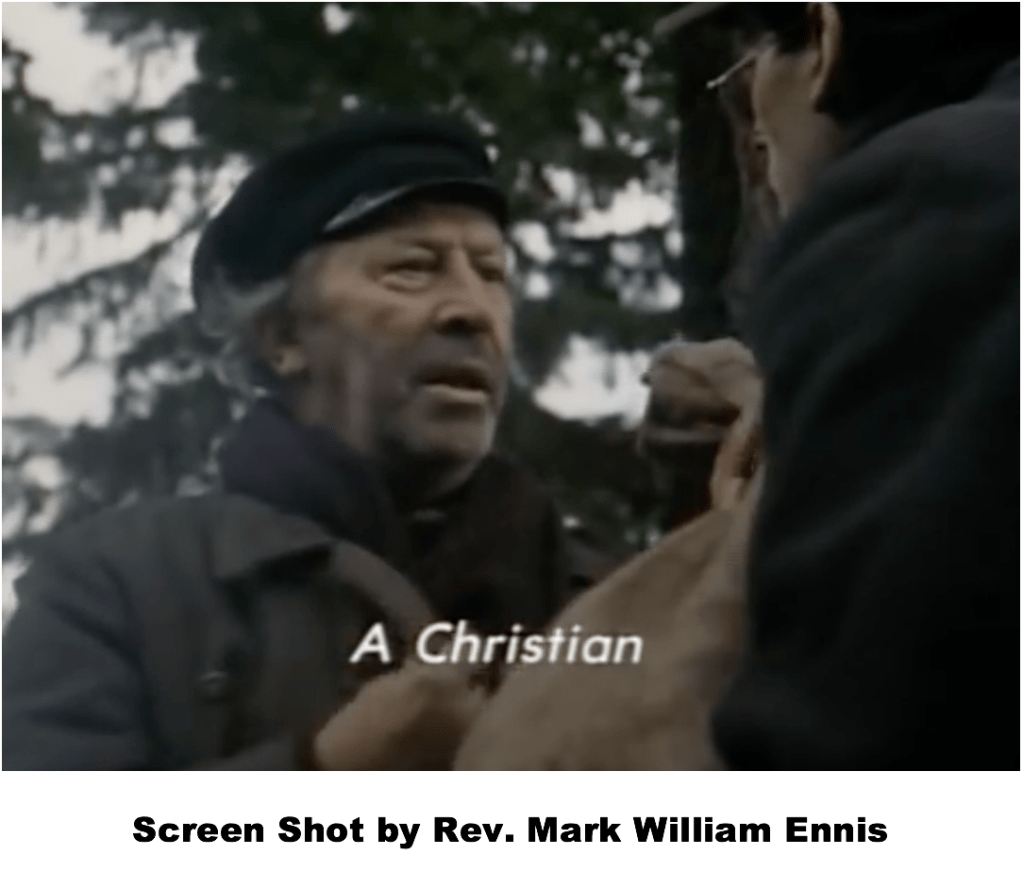
In the middle of this difficult scene came a moment of awe for me. A local farmer carried a sack up to two guards. “Apples,” he proclaimed and he was allowed to walk past the guards and toward the train. The guards allowed him to pass and he brought his gift of apples to the starving Jews.

One of the transportees asks him who he is. He humbly replies, “a Christian.”

How would we answer such a question? If someone asks us who we are would we tell the person our name? Would we identify ourselves by what we were doing? Would we identify ourselves by our nationality or our profession? I admire this farmer who did this good deed who simply identified himself by his religious faith. I hope that we all grow to identify ourselves by our relationship with Jesus above all else.

War and Remembrance https://www.youtube.com/watch?v=eteXEmhiBIo

“I have saved your soul for God.”

Monday Ministerial Musings

By Rev. Mark William Ennis

2022 Blog #28

July 18, 2022

Summer Cinema Scenes in 10 parts

Part 3 “Les Miserables”

“I have saved your soul for God.”

The movie “Les Miserables” haunts me. I will probably watch it one more time during the summer. I love the idea that a former prisoner, Jean Valjean, could be converted to an honest life by the actions of a priest. If you know the story, Jean Valjean spent twenty years in a French prison for stealing a loaf of bread to feed his hungry nephew. Because of this robbery he would spend his whole life on parole and could be sent back to prison for any infraction, no matter how small.

Desperate and hungry he is taken in by a priest into his rectory. There he is well fed and given a place to sleep. Rather than accept this generosity for more than a day, Jean Valjean has another plan. In the early morning hours, he steals much of the silver from the rectory and tries to escape with his ill-gotten gain. Instead of a quick escape, he is caught by the local police. He claims that the priest gave him these things and is quickly brought to the priest to verify this story. The priest, to save Valjean from future imprisonment, lies and says that he gave the silver to the thief. In fact, he even gives Valjean more silver and dismisses the police.

Valjean is in disbelief at the kindness of the priest and is in more disbelief at the priest’s follow up. He claims to have “saved Valjean’s soul for God.”

Valjean, a parolee from prison and a thief, was forgiven by a priest and his transformed by this act of generosity. He goes on to become a model citizen a mayor and a factory owner for whom many people owe him for the livelihoods that he gives them. He also comforts a young woman in her death and adopts this woman’s daughter as his own and give her a wonderful life. Later, he saves the girl’s boyfriend from death after he is shot during an insurrection.

Yes, this seems like a fairy tale. Surely a criminal could not turn around so quickly all because of one act of generosity. And yet, we do find many examples in history of people on their way to a life of crime who were turned around by a loving family member who was a buffer from abuse or even a mentor who helped young people overcome what would have been insurmountable obstacles toward honest lives. This might be rare, but it is not unknown. Many a person was saved from a dead end life by good mentoring.

Are we all willing to be mentors in Jesus’ name? How many lives could we save from destruction if we were all willing to be so faithful. Are we willing to be forgiving, more than worldly people, and help bring about such transformations for others.

Le Mis https://www.youtube.com/watch?v=w6e-qui-K-I


“Into Yours hands I commend my spirit.”

Monday Ministerial Musings

By Rev. Mark William Ennis

2022 Blog #27

July 11, 2022

Summer Cinema Scenes in 10 parts

Part 2 “Gettysburg”

“Into Yours hands I commend my spirit.”

Each Independence Day weekend I enjoy watching the movie “1776” but I also enjoy watching the movie “Gettysburg.” Historically this makes sense as the Civil War battle of Gettysburg was fought from July 1-July 3. The following day, July 4, Vicksburg fell to General Grant and the fate of the confederacy was sealed. Events of these dates in 1863 are as relevant to our history as these dates in 1776.

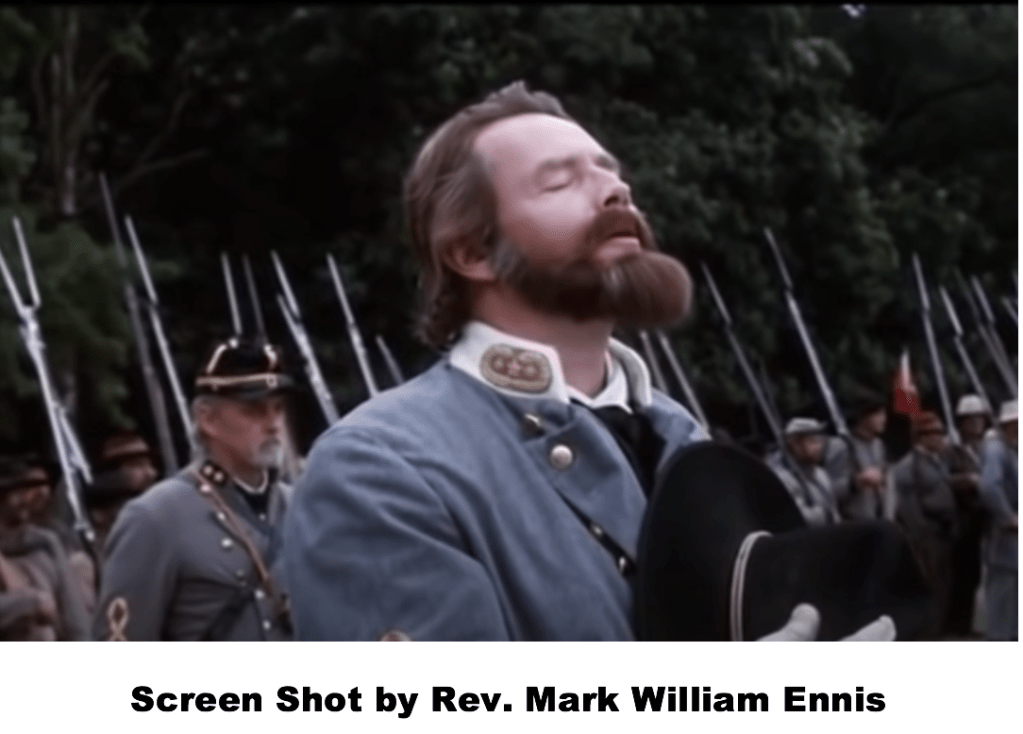
I believe that there are too many magnificent parts of this movie to even begin to discuss it with intelligence but one particular scene stands out in my mind and is a snapshot of the battle, the war, as well as the culture of the nation at that time. This scene shows the prayer of brigadier general Lewis Armistead.

Armistead, like many southerners, considered themselves to be Christian and believed that the war to maintain their way of life was the act of faithful Christians. It seems incomprehensible to us that a Christian would be fighting to maintain slavery, yet we must evaluate people based on their cultural context, not ours.

Armistead believed that he was doing God’s work in defending his state against federal intrusion and in upholding slavery and the culture that supported it. He knew that there was a good chance that he would die but he was willing to face death for causes that he believed were Godly.

Armistead’s brigade was part of Pickett’s division. Armistead, who well understood the risks of this desperate attack which has become known as “Pickett’s Charge”  began to lead his brigade out of the woods and toward the federal positions. He knew that he faced a good chance of being wounded or dying. Just before his march began he removed his hat looked upward and prayed, “into your hands, I commend my spirit.” He believed that he was doing God’s will and was willing to die for it.

Do we have so much commitment? Are we willing to die for what we believe God is calling us to do? Does our faithful commitment to Jesus end at our own safety or our own comfort? I disagree with Armistead that fighting for the confederacy was God’s will. Nevertheless, I appreciate his faithful commitment. He is a role model for all of us who claim the mantle of Christianity.

Armistead was indeed shot during the charge. He died a few days later in a federal prison hospital. I believe that he was wrong, but I cannot fault his dedication and faithfulness.

Gettysburg: https://www.youtube.com/watch?v=mC7bYDBj_eA&t=122s

Summer Cinema Scenes in 10 parts

Part 1 “1776” Molasses to Rum to Slaves

Monday Ministerial Musings

By Rev. Mark William Ennis

2022 Blog #26

July 4, 2022

Summer Cinema Scenes in 10 parts

Part 1 “1776” Molasses to Rum to Slaves

Each year, among other things, I watch the movie “1776” each July 4. I admire the boldness of these founding fathers. A colony removing itself from a mother country was not heard of in 1776. One aspect of this movie that I find disturbing is the debate over slavery. White men were celebrating freedom even while being willing to endorse and continue slavery. It set our new nation on a bad direction that would ultimately end with our civil war and then the civil rights movement of the 1960’s.

This movie is in one sense the story of our nation’s founding. In another sense it is the story of how white people must learn to live with the black people that they imported from Africa. Whites brought them here. How must we live with them?

A southerner, Thomas Jefferson, has vowed to free his slaves but never did. A northerner, John Adams, railed against slavery in a rather self-righteous way. He clearly is portraited as being a bit self-righteous in his condemnation of the southern slave holders.

Edward Rutledge, a delegate from South Carolina to the continental congress, rises to confront John Adams. He points out that although it is the southerners own slaves, it is northern boats that transported those slaves. Whether they like it or not, the northerners, particularly Massachusetts merchants, are very much part of the slave trade that John Adams is condemning. There is a powerful scene as Edward Rutledge sings the song, “Molasses to Rum to Slaves” as he points out the hypocrisy of northern self-righteousness.

This song strikes me hard. How often is it easy to see the faults of others without seeing the faults that we carry with us. Northerners during the civil rights movement felt pride that the north was not as bad as the south was in race relations, yet northerners certainly did not treat black people as equals. This reminds me of Jesus telling his disciples that before one can help take a speck out of a neighbor’s eye we must first take the plank out of our own eye.

I encourage everyone to watch 1776 either for the first time, or once more. It contains many important lessons that it might behoove us to learn from. The song, “Molasses to Rum to Slaves” may be viewed using the link below.

Celebrating An Episcopal Church Bumper Sticker

Monday Ministerial Musings

By Rev. Mark William Ennis

2022 Blog #25

June 27, 2022

Celebrating An Episcopal Church Bumper Sticker

Several weeks ago I took a trip into New York State to attend a family wedding. The trip took seven hours each way. When I was young and making twelve hour trips back and forth to Michigan, such long car trip were fun adventures. Now, forty five years later, these long road trips are lacking in fun or adventure for me. Sometimes, in order to pay attention, I sit and read bumper stickers. On this trip, I found one that I love, compliments of the Episcopal Church.

The bumper sticker proclaimed, “We are the Episcopal Branch of the Jesus Movement.”

When I saw this  sticker I could not help but smile in pride at the faithful boldness of the Episcopal Church. This group of Christians, with this proclamation, is witnessing to the world that it is affiliated with Christ and his church. I can’t help but appreciate, and envy, this act of faithful witness.

I wish that the Reformed Church in America would participate in such an activity. Such a gesture would, I believe, have three effects; the first to get Jesus’ name out before the world. The second would be to get the name of the Reformed Church in America out before the world. Our history is storied but with our small size, we lack any real name recognition. The third would be to proclaim that we are part of a larger movement. Sometimes we feel as though we witness to Jesus all alone. No! The Jesus Movement is a lot bigger and broader than any of the small pieces that we know personally. The Jesus Movement is worldwide and every culture, language and race, participates in this movement.

Yes, we need to celebrate our brand of Christianity. Yes, we need to proclaim Jesus. Yes we need to celebrate that Jesus is a worldwide movement. Maybe bumper stickers might just be a way to begin.

#ReformedChurchInAmerica                                 #PastorMarkAuthor            

#BergenCounty                                                       

#BergenfieldNJ

#Jesus                                                                      

#BumperStickers

#EpiscopalChurch                                                  

#Christianity

To read more of Pastor Mark’s writings, please order copy of his book:https://deepriverbooks.com/books/the-circle-of-seven/